In all redox flow batteries, including vanadium systems, the electrolyte must be electrically conductive. As the system scales up, the number of cells in an electrochemical reactor increases from one to several. When the battery is in operation, the electrolyte fills the channels and manifolds that connect the cells, resulting in the generation of shunt currents. These shunt currents affect the Coulombic efficiency of the redox flow battery stack, leading to a decrease in the overall energy efficiency and round-trip efficiency of the system.
The value of the shunt current between the cells depends on several factors, including: – The number of cells in the battery stack
- The geometry of the manifolds and flow channels
- The conductivity of the electrolyte (including its chemical composition)
- The state of charge (SOC) of the electrolyte during battery cycling
- The operating current
If the number of stacks and the chemical composition of the electrolyte are fixed, the most effective way to reduce shunt current is to make the manifolds narrower and the flow channels thinner and longer. However, excessively lengthening the flow paths can result in a high pressure drop within the stack, which is undesirable because it increases electricity consumption by the pumps. Therefore, shunt current calculations should be performed alongside fluid dynamic simulations to balance shunt current values and pressure drop.
At Inohub Energy, we prioritize monitoring shunt current values for our stacks and are actively engaged in both shunt current and fluid dynamic simulations.
ACKNOWLEDGEMENT:
This work was supported by the project: IPCEI_IE_FLOW_BESS_012021_2. phase
Illustrations:
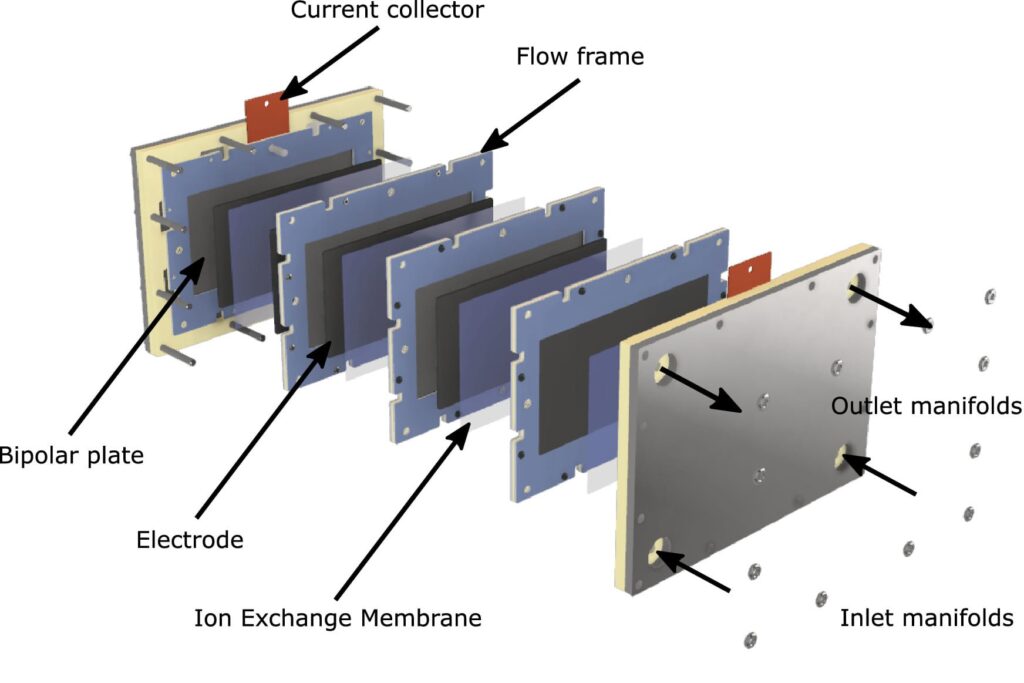
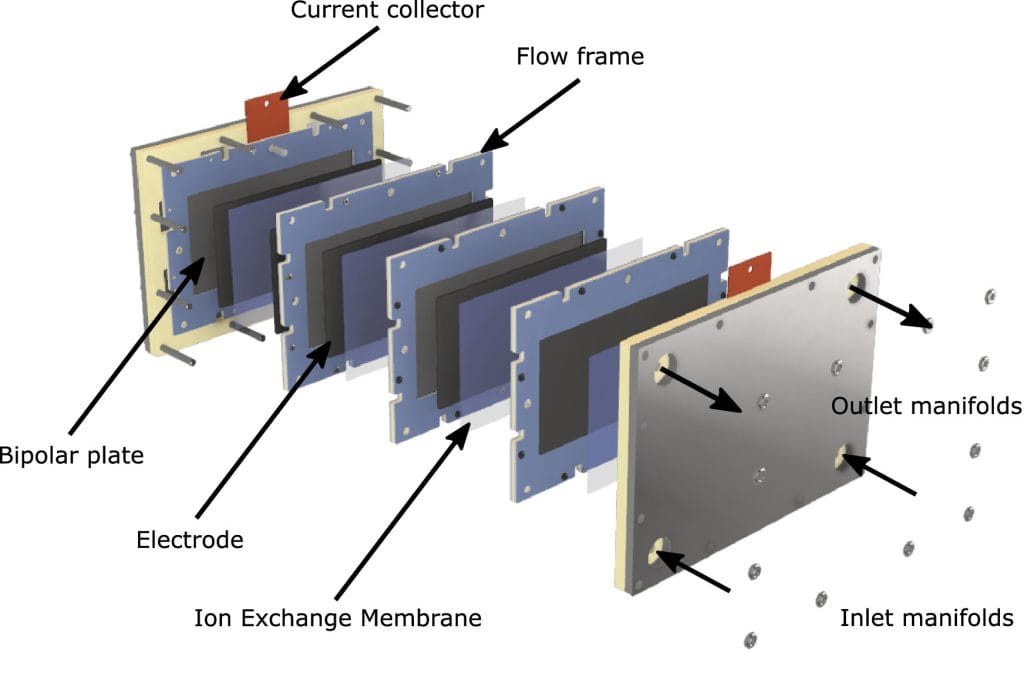
1) Example of the part of 4 cells redox flow battery stack.
2) Schematic representation of the vanadium redox flow stack while charging with 6 cells, and dimensions of the flow frame channels and manifold (in mm).
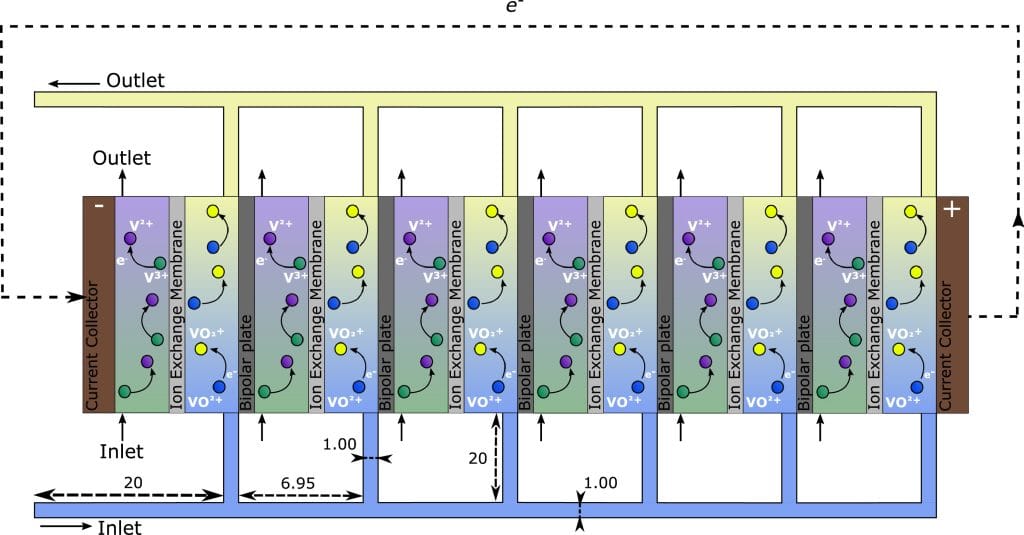
3) Schematic representation of the equivalent circuit model used to simulate shunt currents in the VRFB stack with N cells.
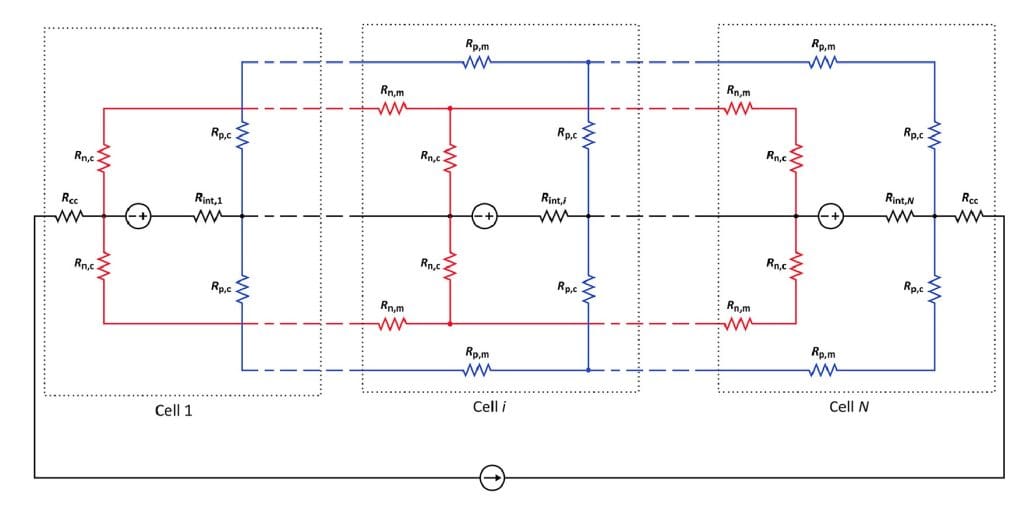
Source for illustrations: Nuno M. Delgado, Ricardo Monteiro, Jorge Cruz, Anders Bentien, Adélio Mendes, Shunt currents in vanadium redox flow batteries – a parametric and optimization study, Electrochimica Acta, Volume 403, 2022, 139667, ISSN 0013-4686, https://doi.org/10.1016/j.electacta.2021.139667.